Modern civilization's civilization immunity principle
The Dark ForestModern civilization's civilization immunity principle is the name given to the post-crisis conviction that humanity must not again allow the demands of survival strategy to destroy the human life it claims to protect. It emerges after the Great Ravine as a collective reaction to famine, social collapse, and the enormous price imposed by the war effort. The principle makes humanism the first priority and the continuation of civilization the second, and it becomes the moral basis of the society Luo Ji encounters after his long hibernation.
Definition and Historical Origin
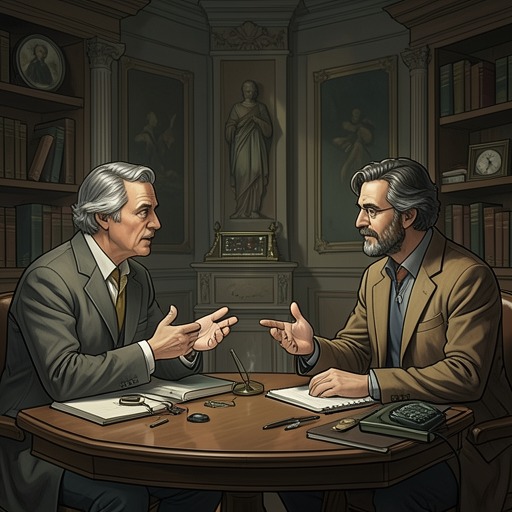
Modern civilization's civilization immunity principle is explained to Luo Ji by an economist who had also spent time in hibernation. He describes civilization as having suffered a serious illness: the trauma itself activates an immune system that prevents a recurrence of the conditions that produced the early Crisis Era. The formulation reverses the priorities of wartime mobilization. Rather than treating individuals as expendable units in the service of an abstract future, it makes present human welfare the standard by which political decisions are judged.
The principle arose when people began asking whether victory in the Doomsday Battle justified the suffering demanded by the defense program. The decisive moral image was not an abstract calculation of species survival but the contrast between a child dying of starvation in someone’s arms and the continuation of human civilization. Although choosing immediate human welfare over military necessity was initially condemned as treasonous thinking, the attitude spread until it became the conviction of the entire world. The accompanying slogan, “Make time for civilization, for civilization won’t make time,” expresses a demand that civilization serve living people rather than consume them.
Social and Political Consequences
Once this outlook prevailed, the new national governments ended their space strategies and redirected their attention toward improving people’s lives. Genetic engineering and fusion technology enabled large-scale food production, ending dependence on weather and bringing the world out of hunger. Population decline accelerated the recovery, and within two decades living conditions returned to pre-Great Ravine levels before reaching the standards of the Golden Age. Comfort was not merely an accidental benefit of recovery; it became the road on which society had consciously set its heart.
The principle also changed the way humanity treated renewed strategic preparation. After roughly half a century of peace, the world again turned its attention to the Trisolaran invasion and declared a global state of war. Yet the new constitutions required that resources devoted to space strategy remain within a specified range and avoid a disastrous effect on the economy or community life. The military response was therefore permitted, but only under a political order designed to prevent wartime priorities from consuming society a second time. This constitutional restraint helped produce the later separation of the space fleets into independent countries.
Contrast with Earlier Crisis Logic
The principle stands in sharp opposition to the logic that had governed the early defense effort. During the Trisolar Crisis, the Earth was exposed to the enemy through the continuing arrival of sophons: meetings, files, computer storage, military details, and strategic decisions could all be observed. The Wallfacer Project was created because humanity’s inner thoughts remained inaccessible to the sophons, allowing secret plans to survive only within individual minds. That emergency elevated strategic deception and mobilization above ordinary transparency and ordinary political limits.
The same crisis also revealed why humanity’s advantage in deception mattered. The Trisolarans communicated through direct, open thoughts and were therefore described as deficient in tricks, camouflage, and deception. The Wallfacer Project sought to preserve the human capacity for misdirection by giving selected individuals authority to formulate plans entirely in their minds while presenting false intentions to the world. Modern civilization's civilization immunity principle does not deny the reality of such threats, but it refuses to let the permanent possibility of threat restore the social conditions that made the crisis morally intolerable.
The Principle Under Renewed Danger
The later return of existential danger tests whether civilization immunity can survive an actual emergency. The assassination order against Luo Ji and the genetic weapon directed at him demonstrate the continuing reach of the conflict: the Lord orders Luo Ji’s destruction, and a genetically altered virus identifies its target before creating deadly toxins in his blood. These attacks show that danger remains capable of selecting and pursuing individuals with extraordinary precision, even while society tries to live according to post-crisis principles.
The destruction of the combined human fleet by the droplet exposes the same tension on a larger scale. The fleet’s battle information system records a powerful, invisible enemy force, while the commanders are left in numb shock by the destruction of a hundred warships in less than a minute. When the droplet then approaches Earth, the world’s emergency is displayed through a countdown of four hours and fifty-four minutes. Yet the underground city does not respond with a single unified civic purpose. Some people sit in despair, while others celebrate amid burning trees, crashed flying cars, falling debris, and a ruptured pipe whose water becomes part of their revelry. The scene presents a society whose old strategic certainties have collapsed, but whose new commitment to individual life has also produced no simple collective answer.
Ethical and Narrative Significance
Modern civilization's civilization immunity principle gives the post-Great Ravine era its defining moral vocabulary. It treats the preservation of civilization as inseparable from preserving the lives, choices, and daily welfare of the people who constitute it. In that sense, the principle is neither simple pacifism nor indifference to the Trisolaran threat: humanity eventually resumes war preparation, but only after imposing explicit limits on what war may take from society.
Its deeper significance lies in the conflict between two legitimate claims. Strategic necessity demands sacrifice, secrecy, and the concentration of resources; civilization immunity insists that a civilization defeated in its manner of living may already have lost what it sought to defend. The principle therefore functions as both a lesson and a vulnerability. It protects humanity from repeating the early crisis, yet the approach of the droplet asks whether a society organized around life can act decisively when survival again requires violence, risk, and collective sacrifice.